

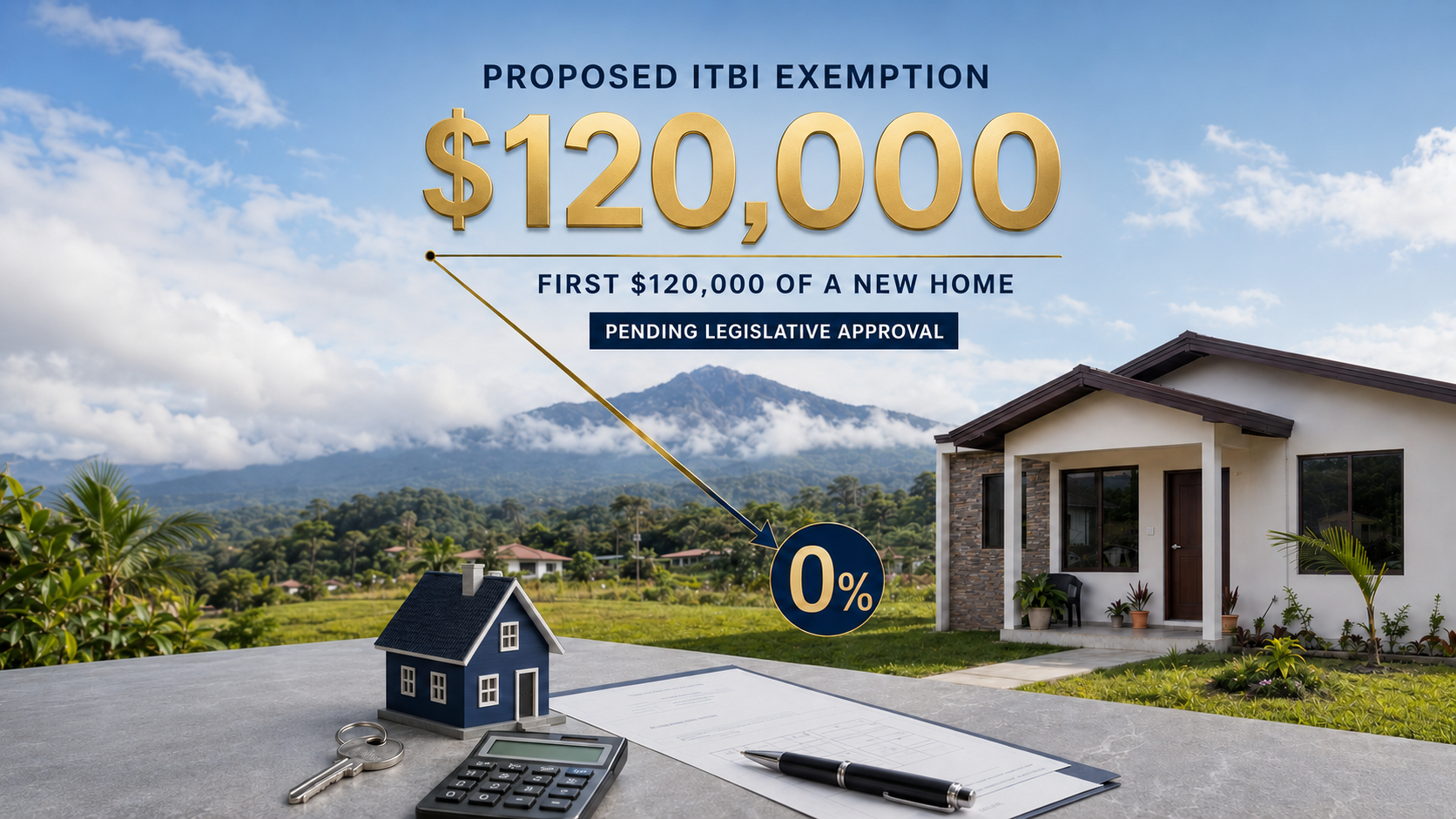
Panama’s Cabinet Council approved a bill on July 29, 2026, that could reduce the Real Estate Transfer Tax payable by sellers on the first sale of qualifying new homes. Panama calls this tax the Impuesto de Transferencia de Bienes Inmuebles, or ITBI.
The proposal would eliminate the seller’s ITBI liability on the first $120,000 of a qualifying new home’s sale price. A seller transferring a new home priced at $120,000 or less would owe no ITBI. For a qualifying home priced between $120,001 and $200,000, the seller would receive an exemption on the first $120,000 and pay a preferential rate on the remaining amount.
For example, on the first sale of a qualifying new home priced at $180,000, the developer or promoter, as the seller, would calculate the ITBI only on the remaining $60,000.
This does not mean that the buyer receives a tax credit or claims the exemption directly. The ITBI is legally payable by the seller. However, buyers may benefit indirectly if the measure reduces a transaction cost that developers otherwise factor into the pricing or financial structure of a new-home sale.
The proposal is not yet in effect. The National Assembly must discuss and approve the bill before it can become law. Its conditions, rates and effective date could change during that process.
What Is Panama’s ITBI?
The ITBI applies when a property owner transfers real estate to another party in Panama. It differs from the annual property tax that owners may pay after purchasing a home.
Under Panamanian law, the seller, not the buyer, is responsible for paying the ITBI. In the first sale of a newly built home, the developer or promoter generally acts as the seller and therefore carries this tax obligation.
The proposed legislation reinforces that distinction. According to the announced terms, any agreement that attempts to transfer the ITBI obligation directly or indirectly to the buyer would be invalid.
Although buyers do not legally owe the tax, the ITBI may still affect the overall economics of a transaction. Developers consider taxes, construction expenses, financing and other project costs when structuring the sale of a home. Reducing the ITBI could therefore remove one of the costs associated with bringing qualifying new homes to market.
Qualifying new homes benefited from special ITBI treatment for more than 50 years. That treatment expired on December 31, 2025. As a result, developers and promoters began assuming the applicable transfer tax when completing new-home sales in January 2026.
Representatives from Panama’s real estate and construction sectors argued that this additional seller-side expense could affect new-home pricing, mortgage affordability and the pace of home sales. The proposal seeks to address those concerns by restoring tax exemptions and preferential rates for qualifying new-home sales.
What Would Change Under the Proposed Law?
The bill would reduce the ITBI payable by the seller on the first sale of a qualifying new home. It would exempt the first $120,000 of the property’s sale price from the tax.
The proposed structure would work as follows:
- If the new home costs $120,000 or less, the seller would owe no ITBI.
- If the home costs between $120,001 and $200,000, the seller would receive an exemption on the first $120,000.
- The seller would calculate the ITBI only on the portion above $120,000, using the preferential rate corresponding to the home’s total sale price.
The proposal also expressly maintains the ITBI as the seller’s responsibility. It would invalidate any contractual arrangement that attempts to transfer that legal obligation directly or indirectly to the buyer.
Buyers should therefore not interpret the exemption as a separate discount, refund or tax credit payable to them. Instead, they should compare the property’s total sale price, request an itemized closing-cost estimate and confirm that the developer has not included the seller’s ITBI as an expense payable by the buyer.
Proposed ITBI Rates for Sellers of New Homes
If the National Assembly approves the current proposal without changing its rate structure, the following scale would apply to sellers completing the first sale of qualifying new homes:
| Total value of the new home | Proposed ITBI rate | Portion on which the seller would pay ITBI |
| Up to $120,000 | 0% | None |
| $120,001–$130,000 | 0.50% | Amount above $120,000 |
| $130,001–$150,000 | 1.00% | Amount above $120,000 |
| $150,001–$170,000 | 1.40% | Amount above $120,000 |
| $170,001–$190,000 | 1.60% | Amount above $120,000 |
| $190,001–$200,000 | 1.80% | Amount above $120,000 |
All amounts shown in this table refer to the seller’s potential ITBI liability. They are not taxes payable by the buyer.
These rates form part of the bill approved by the Cabinet Council. The National Assembly may modify them before approving the final law.
How Much ITBI Would the Seller Pay?
The following examples illustrate the seller’s estimated ITBI liability under the announced proposal. In each case, the developer or promoter, as the seller, would apply the corresponding preferential rate only to the portion of the sale price above $120,000.
| New home price | Taxable portion | Proposed rate | Estimated ITBI payable by the seller |
| $120,000 | $0 | 0% | $0 |
| $130,000 | $10,000 | 0.50% | $50 |
| $150,000 | $30,000 | 1.00% | $300 |
| $170,000 | $50,000 | 1.40% | $700 |
| $180,000 | $60,000 | 1.60% | $960 |
| $200,000 | $80,000 | 1.80% | $1,440 |
These figures provide estimates based on the proposal’s announced rate structure. They do not represent final closing quotes. The approved law, its regulations and the details of each transaction will determine the actual amount payable by the seller.
Which New-Home Sales Could Qualify?
The proposal focuses on the first sale of a newly built residential property. Therefore, eligibility would depend principally on the property and the nature of the transfer, rather than on the buyer personally applying for an ITBI exemption.
This distinction matters because “first sale” refers to the property transaction. It means that the sale must involve a qualifying new residential property that the developer or promoter has not previously sold.
The proposal could cover:
- The first sale of a qualifying new home priced at $120,000 or less, leaving the seller with no ITBI liability.
- The first sale of a qualifying new home priced between $120,001 and $200,000, giving the seller an exemption on the first $120,000 and a preferential rate on the remainder.
The announced treatment would not apply to ordinary resale transactions because those properties no longer qualify as first sales of newly built homes.
Current reporting also indicates that the buyer and seller may need to formalize the sale within two years after the property receives its occupancy permit. Buyers should confirm this requirement after the National Assembly publishes and approves the final text.
What About New Homes Priced Above $200,000?
The announced preferential scale covers new homes priced up to $200,000. Buyers considering a property above that amount should not assume that the exemption or reduced rates would apply in the same way.
The final legislation must clarify how the ITBI would apply to sellers transferring homes priced above $200,000. Until then, buyers in that price range should request a transaction-specific calculation from their attorney or tax adviser.
ITBI Is Not the Same as Panama’s Preferential Interest Law
The proposed ITBI exemption and Panama’s Preferential Interest Law address different parts of a home purchase.
The ITBI applies to the transfer of property, and the seller carries the legal responsibility for paying it. The Preferential Interest Law, in contrast, subsidizes part of the interest rate on qualifying mortgages and can reduce the borrower’s monthly payment.
A home could potentially fall within both programs, but each one uses its own eligibility requirements, price ranges and procedures. Qualification under one program would not automatically guarantee qualification under the other.
What Buyers Should Do While the Bill Remains Pending
Buyers do not need to pause their property search, but they should avoid building a purchase budget around an exemption that has not yet become law.
Anyone evaluating a new home can take several useful steps now:
- Ask the developer to confirm in writing that the seller will assume the ITBI and that the buyer’s closing-cost estimate does not transfer this obligation directly or indirectly to the buyer.
- Request an itemized estimate of the purchase and closing expenses.
- Confirm the date of the occupancy permit and whether the transaction qualifies as the first sale of a new home.
- Ask how the contract would address a legal change that takes effect before the transaction closes.
- Consult a Panamanian attorney before signing a reservation agreement or promise to purchase.
These questions can help buyers compare properties under the same financial assumptions and understand whether a future tax change could affect the structure of their transaction.
What Is the “Abono Inicial Pa’ Ti” Program?
The Panamanian government has also announced plans for a program called Abono Inicial Pa’ Ti. The initiative would provide financial support toward the down payment on qualifying social-interest homes.
Government officials have indicated that the program will involve coordination with banks and developers. However, they have not yet published all eligibility requirements, contribution amounts or application procedures.
Buyers should therefore treat Abono Inicial Pa’ Ti as a separate developing initiative. It does not form part of the ITBI calculation, and its announcement does not guarantee that a particular buyer or property will qualify.
What Could the Proposal Mean for Panama’s Housing Market?
The proposal could have its greatest direct effect on sellers of qualifying new homes priced at or below $200,000. This segment serves many local households that rely on mortgage financing and have limited flexibility for additional upfront expenses.
Lower transfer costs could help developers manage the overall cost structure of qualifying new-home sales. The change may also support mortgage activity because banks generally finance the property’s approved value but may not cover every tax or transaction-related expense.
However, the ITBI represents only one part of housing affordability. Mortgage rates, household income, down-payment requirements, project inventory and bank lending criteria will continue to influence whether a buyer can complete a purchase.
Planning to Buy a New Home in Panama?
The proposed legislation would reduce the ITBI liability of developers and promoters when they act as sellers of qualifying new homes. It would not create a tax credit or direct exemption that buyers could claim.
Nevertheless, buyers may benefit indirectly if the measure reduces a cost associated with the sale of new residential properties. They should wait for the National Assembly to approve the final legislation before assuming that the proposed treatment will apply to a particular purchase.
Casa Solution helps buyers compare properties, review local market conditions and understand the costs that may influence a real estate purchase in Panama. Our team can help you identify homes that match your preferred location, budget and long-term plans while qualified legal and financial professionals verify the structure of the transaction.
Contact Casa Solution to begin your property search in Panama.
This article provides general information and does not constitute legal, tax or financial advice. Buyers should obtain advice based on their specific transaction.
Article written: July 31, 2026
The project’s legislative status, proposed ranges and seller-payment requirement reflect information available as of July 31, 2026, as reported by La Prensa.