
Article written: October 8, 2026
What did Panama get out of its state visit to Singapore?
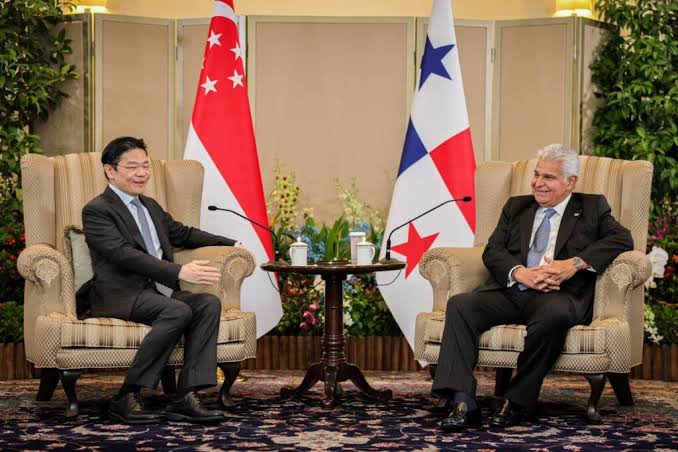
A new signatory for the Panama Canal’s neutrality protocol, an air cargo agreement for Tocumen and a list of interested investors. On October 5, Singapore Prime Minister Lawrence Wong told President José Raúl Mulino that Singapore will adhere to the Protocol to the Treaty Concerning the Permanent Neutrality and Operation of the Panama Canal.
The announcement came on the last day of Mulino’s October 3 to 5 state visit, which also produced an airport cargo deal, the start of negotiations on a Mutual Legal Assistance Treaty and plans for a bilateral commission to develop joint projects.
What Is the Panama Canal Neutrality Protocol?
The Neutrality Treaty, signed in 1977 alongside the Torrijos-Carter treaties, establishes that the Canal stays permanently neutral and open to ships of all nations. Its protocol is open to any country that wants to formally commit to respecting that neutrality.
In May, Panama raised the number of adhering countries to 40 after Austria, Belgium, Portugal and Switzerland joined. Singapore’s Ministry of Foreign Affairs said the decision reflects its commitment to maritime security, freedom of navigation and the 1982 UN Convention on the Law of the Sea.
For one of the world’s busiest port nations, the signal matters. Mulino welcomed it, saying Panama was “very pleased” that Singapore had taken the step.
What Is the SATS and Tocumen Air Cargo Agreement?
Mulino and Wong witnessed the signing of a memorandum of understanding between SATS Ltd., a Singapore-based air cargo handling and aviation services company, and Tocumen International Airport.
The two will explore ways to strengthen air cargo connectivity and position Panama as a logistics gateway for the Americas. It is a memorandum, not a contract, so no investment figures were announced.
Which Projects Did Panama Pitch to Singapore Investors?
On October 3, Foreign Minister Javier Martínez-Acha met with Singaporean business representatives from the maritime, pharmaceutical, real estate, health and legal sectors. He presented the government’s Strategic Plan 2025-2029 and its main projects:
| Project | Details shared |
|---|---|
| Road reactivation program | Multimillion-dollar investment expected to create more than 7,000 jobs |
| Fourth Bridge over the Panama Canal | Presented as a priority mobility project |
| Tocumen International Airport | Expansion of the airport platform |
| Regional airports | Expansion and development |
| Other sectors | Ports, hospitals and the electrical interconnection with Colombia |
No investment commitments were announced. Singaporean companies were invited to the III Latin America and Caribbean Economic Forum, which Panama hosts in January 2027.
What Did Mulino See at Singapore’s Tuas Port?
Mulino toured Tuas, Singapore’s automated mega-port. Once its four phases are complete, Tuas is planned to handle 65 million TEU a year across 66 berths stretching 26 kilometers. Mulino cited its automation and container handling as a model Panama can study for its own logistics platform. He also met Singapore’s President Tharman Shanmugaratnam to discuss port infrastructure and cooperation.
Singapore and Panama are two small countries that built their economies on the same idea: sitting where global trade has to pass. Seeing one formally back the neutrality of the other’s Canal, and start working together on cargo and logistics, is a natural fit that could pay off for both in the years ahead.
Sources: La Prensa, Telemetro, La Estrella de Panamá, Eco TV.