
What did Panama’s government actually declare? On August 26, the Cabinet Council approved Resolution No. 102-26, putting Panama under a national state of emergency because of the effects of El Niño. The declaration doesn’t only cover drought, it also responds to flooding that has already displaced and affected thousands of people this year.
Panama is now the third Central American country to take this step, following Honduras and El Salvador, as this year’s El Niño event intensifies across the region.
Why the Government Declared an Emergency Now
Interior Minister Dinoska Montalvo said the declaration will allow authorities to “be prepared for what may come with El Niño.” The resolution enables special emergency contracting through June 30, 2027, so government institutions can move faster on mitigation and response work without the delays of Panama’s standard procurement process.
The stated objectives are to adopt preventive and mitigation measures, strengthen the operational capacity of public institutions, safeguard public safety in emergencies, and provide timely attention to affected citizens and their property.
Who’s Already Been Affected
Official figures cited alongside the declaration record at least 15,643 people affected by flooding from January 2026 to date. More than 70% of that total is concentrated in two provinces, Bocas del Toro and Colón, with the remainder in the Ngäbe Buglé and Naso Tjër Di regions.
That’s a useful reminder that El Niño years in Panama don’t only mean drought. The same weather pattern can produce flooding in some provinces at the same time it’s drying out others, which is part of why the emergency declaration covers both extremes rather than one.
How Long This Is Expected to Last
According to forecasts from Panama’s Institute of Meteorology and Hydrology (IMHPA), the phenomenon is expected to intensify, with rainfall deficits deepening across October, November and December 2026, and continuing into January, February and March 2027. The broader effects, including elevated temperatures that could affect the population, agriculture and water resources, are expected to extend until May 2027.
In other words, this isn’t a short-term weather event the government expects to pass in a few weeks. The emergency declaration and the special contracting authority attached to it are built around a response window of roughly nine months.
The Direct Line to the Panama Canal
This declaration doesn’t stand apart from the water shortage already affecting the Panama Canal. The canal draws its operating water from two rain-fed lakes, Gatún and Alajuela, and this year’s rainfall has already come in well below the historical average.
The Panama Canal Authority had already begun tightening draft limits on large vessels, capping ships at 14.63 meters starting August 26 and 14.48 meters starting September 3, while reducing daily transits from 36 to 34 in early September, with a further cut to 32 expected by mid-September.
With the national emergency now confirming that rainfall deficits are expected to deepen through the rest of the year rather than ease, those restrictions are more likely to hold, or tighten further, than to reverse in the short term.
What This Means If You Live or Own Property Here
For residents and property owners, a national emergency declaration is primarily an administrative tool. It doesn’t change day-to-day life directly, but it does put government agencies on a faster operational footing to respond to flooding, water shortages and related infrastructure issues over the coming months.
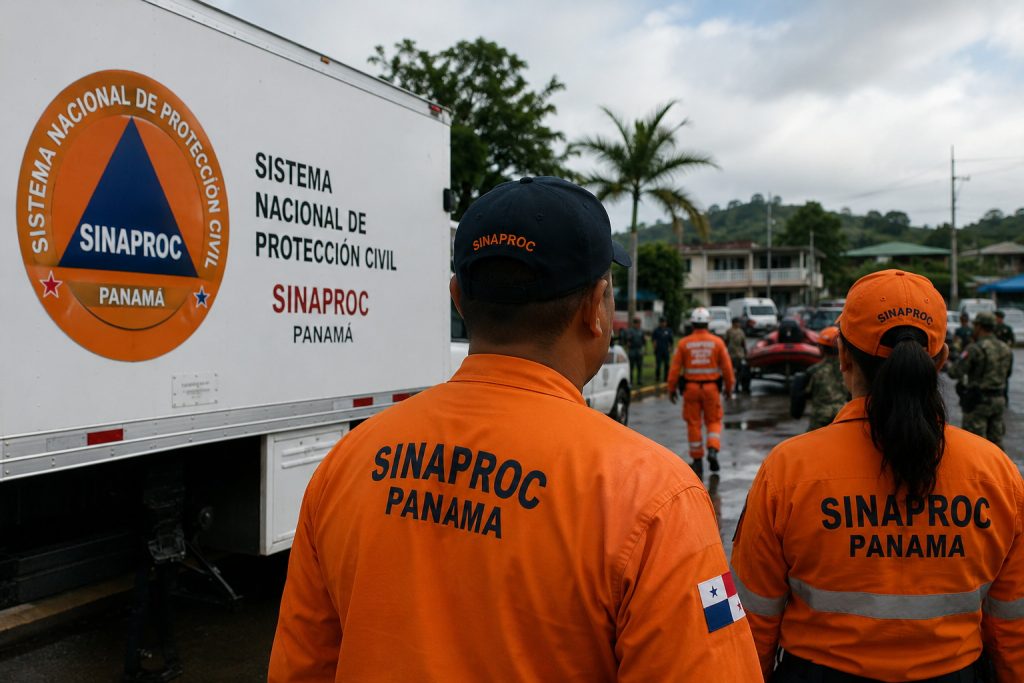
For anyone in Bocas del Toro, Colón, or the comarca regions named in the official figures, it’s worth paying attention to municipal and Sinaproc guidance in the weeks ahead, since those are the areas most likely to see direct government response activity under this declaration.
For everyone else, the more relevant takeaway may be the one connecting this declaration to the canal: a global weather pattern that started with an unusually strong Pacific Ocean warming trend is now shaping government policy, shipping capacity and water planning here in Panama, in real time.