

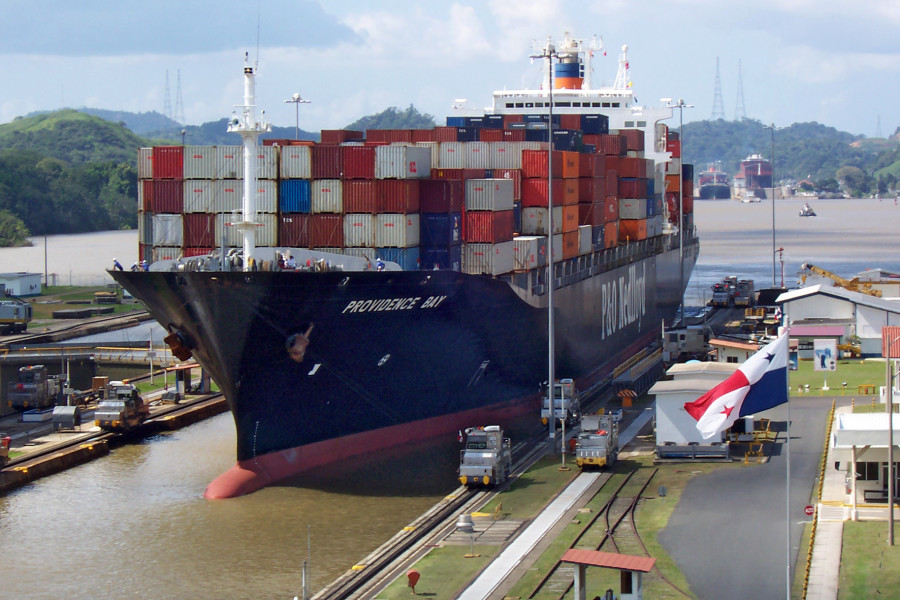
How much will the Panama Canal contribute to the Panamanian State in fiscal 2027?
The Canal will transfer $3,607.8 million directly to the National Treasury during the fiscal year running from October 1, 2026 to September 30, 2027. That is $414 million more than the figure approved for fiscal 2026. The Cabinet Council approved the budget bill on Tuesday, September 1, 2026, and Canal Affairs Minister José Ramón Icaza presented the figures at a press conference.
The bill now goes to the National Assembly for review and approval. The Canal’s Board of Directors had already approved it through Acuerdo No. 459 of August 11, 2026.
The Full Numbers
| Line item | Fiscal 2027 |
|---|---|
| Estimated total revenue | $5,555.3 million |
| Operating expenses | $1,784.5 million |
| Direct contributions to the State | $3,607.8 million |
| Increase over the fiscal 2026 budget | $414 million |
| Tonnage duty | Rises from $1.00 to $1.75 per ton |
| Tolls and customer tariffs | Unchanged |
| Period covered | October 1, 2026 to September 30, 2027 |
The proportions are worth pausing on. Of $5,555.3 million in projected revenue, $1,784.5 million goes to running the waterway and $3,607.8 million goes to the country. Roughly 65 cents of every dollar the Canal expects to earn next year is destined for the National Treasury.
Why the Tonnage Duty Went Up Without Tolls Going Up
The budget includes a Board decision to raise the tonnage duty charged on cargo transiting the Canal from $1.00 to $1.75 per ton. Read quickly, that looks like a price increase being passed to shipping lines and eventually to consumers.
Icaza was emphatic that it is not. He stated that the adjustment does not under any circumstance represent an additional cost for Canal users, and that tolls and tariffs remain exactly the same.
He also clarified a second point that is easy to misread: the tonnage duty increase neither raises nor lowers what the Canal transfers to the State. The $3,607.8 million figure follows its own growth path and is not a product of that adjustment.
The tonnage duty is an internal accounting mechanism between the Canal Authority and the State rather than a charge added to a shipping line’s invoice. Anyone reading headlines about a Canal fee increase this month should keep that distinction in view.
The Timing Deserves Attention
This budget was approved during the same fortnight that the Canal Authority has been managing water constraints ahead of a projected El Niño.
Daily transit slots were capped at 34 for booking dates from September 4 and drop to 32 from September 15. At the same time, the Authority announced it would hold the maximum authorized draft for Neopanamax vessels at 48 feet and postponed a planned reduction to 47.5 feet that had been scheduled for October 1.
So the government is projecting a $414 million increase in Canal contributions in the same period it is restricting how many ships can cross each day. Those two facts are not contradictory. Revenue depends on vessel size and cargo mix as much as on transit counts, and the Canal has been carrying larger ships. But the budget is a projection, not a receipt, and the January to April 2027 dry season sits inside the fiscal year it covers.
What This Means for the Wider Economy
For anyone weighing an investment in Panama, the Canal transfer is one of the clearest indicators of the country’s fiscal position, because it is a large, recurring, non-tax revenue stream that most governments simply do not have.
It also lands alongside other recent signals. A report published in early September by UBS Global Wealth Management projected Panamanian GDP growth of around 5% for 2026, noted that economic activity grew 5.5% in the first half, and observed that the four-quarter fiscal deficit had fallen to 3.3% of GDP from a peak of 6.4% in early 2025. A rising Canal contribution is part of how that consolidation gets done.
The budget also funds projects under the Panama Canal Strategic Plan 2025-2035, which the Authority frames around maintaining operations on criteria of safety, efficiency, profitability and neutrality.
For longer context, the Canal has contributed more than $31.2 billion to Panama’s public finances across 26 years under Panamanian administration. Next year’s $3.6 billion would represent roughly a tenth of that entire total in a single fiscal year.
What Happens Next
The bill requires National Assembly approval before it takes effect on October 1, 2026. In prior years the Assembly’s Budget Committee has reviewed the Canal budget in first debate before it reaches the full floor, and the constitutional process continues from there.
Casa Solution Can Help
Panama’s fiscal strength is one of the reasons international buyers look here rather than elsewhere in the region, and the Canal is a large part of that story. If you are considering property in Panama and want to understand the market rather than the headlines, Casa Solution can help you evaluate specific properties and the areas around them.
Article written: September 5, 2026