
The Panama Canal Authority’s proposed interoceanic gas pipeline is one of the most important infrastructure ideas currently being discussed in Panama. The project would form part of the Canal’s broader 2025-2035 strategy, which includes water security, new port terminals, logistics expansion, and the development of an energy corridor across the isthmus.
At its core, the project is simple to understand. Instead of moving certain gas products by ship through the Canal locks, Panama would move them through a pipeline from one coast to the other. The products discussed include propane, butane, and ethane, which are commonly grouped under liquefied petroleum gas and related energy products. These are widely used in heating, cooking, petrochemicals, industrial production, and energy supply chains.
But the real story is bigger than a pipeline. This project could help Panama move from being mainly a maritime transit route to becoming a more complete energy logistics platform.
Why the Route Matters
One of the main points raised in the current debate is whether the pipeline should follow a Canal-area route managed by the ACP or use the existing Petroterminal de Panama corridor between Chiriquí Grande, Bocas del Toro, and Puerto Armuelles.
The comparison matters. The Canal-area route is shorter, roughly 75 to 76 kilometers, and follows lower terrain. The alternative PTP route is about 131 kilometers and crosses more difficult mountain geography, including higher elevations, river crossings, and more socially and environmentally sensitive areas.
That does not mean western Panama should be excluded from future energy development. In fact, Chiriquí and Bocas del Toro already have a history in petroleum logistics. However, for this specific project, the ACP route appears to offer clearer advantages in execution speed, construction risk, maintenance cost, and operational reliability.
For a country competing globally, those details matter. Panama is not just competing with another local route. It is competing with other maritime and energy corridors around the world.
What New Industries Could Develop?
The most obvious new industry is energy transshipment. Panama already transships containers, vehicles, grains, and bulk cargo. A gas pipeline would allow the country to deepen its role in energy cargo flows between the Gulf of Mexico and Asia.
That could lead to several related industries:
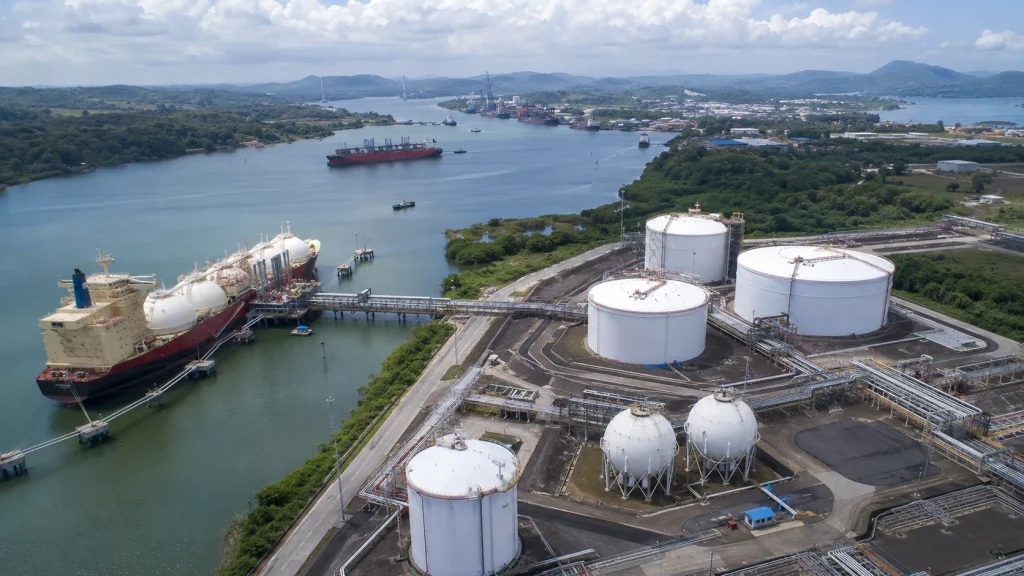
First, specialized energy terminals. These facilities would require storage tanks, refrigeration systems, safety systems, marine loading equipment, and high-level operations management.
Second, maintenance and industrial services. Pipelines, tanks, docks, pumping stations, and refrigeration plants require constant inspection, engineering, repair, technology, security, and environmental monitoring.
Third, power infrastructure. The project would likely need new energy supply capacity, which could support broader upgrades in the Canal area and nearby logistics zones.
Fourth, technical employment. Panama would need more welders, marine engineers, pipeline technicians, safety inspectors, automation specialists, environmental consultants, logistics managers, and port operators.
Fifth, value-added logistics. Over time, Panama could develop more services around cargo scheduling, blending, storage, documentation, insurance, compliance, customs, financing, and trade support.
This is where the project becomes especially interesting. The greatest economic value may not only come from pipeline fees. It may come from the ecosystem that forms around the pipeline.
How Panama Compares to Other Corridors
Panama’s main advantage is geography, but geography alone is not enough anymore. The country already has the Canal, major ports, the Colon Free Zone, Tocumen International Airport, and a dollarized economy. A gas pipeline would add another layer to that platform.
Compared with traditional sea routes, the project could reduce pressure on Canal transit slots and move certain energy cargoes without using additional Canal water. That is important because recent drought periods showed how vulnerable global shipping can be when water levels affect Canal capacity.
Compared with other countries trying to build logistics hubs from scratch, Panama already has a base. The ships, ports, banks, lawyers, insurers, freight companies, and multinational users are already here. The pipeline would build on existing strengths rather than inventing a new economy from zero.
Possible Real Estate and Investment Effects
The direct property impact would likely be strongest around logistics and industrial zones, not beach or retirement markets. Areas connected to the Canal economy, including Panama City, Colón, and Panama Pacifico, could see more demand for industrial land, warehouses, offices, worker housing, technical service facilities, and commercial support services.
This does not mean prices would rise everywhere or immediately. Large infrastructure projects take years, and the final effect depends on approvals, environmental standards, financing, concession terms, and execution. But if the project advances, investors should watch areas tied to logistics, ports, energy services, and skilled employment.
For residents and expats, the broader benefit could be a stronger national economy, more specialized jobs, improved infrastructure, and greater confidence in Panama’s long-term competitiveness.
A Bigger Step for Panama
The gas pipeline should not be seen only as a Canal project. It is a test of Panama’s ability to plan strategically, execute complex infrastructure, protect communities, and compete for high-value global industries.
If done correctly, the project could help Panama earn more from its location, reduce pressure on Canal water usage, attract major international operators, and create a more sophisticated logistics and energy economy.
For property investors, the key is to follow the secondary effects. Infrastructure creates opportunity not only where it is built, but also in the services, housing, commercial areas, and business districts that grow around it.
Casa Solution Real Estate helps buyers, sellers, residents, and investors understand how major national developments may affect Panama’s property market. If you are exploring real estate opportunities in Panama, our team can help you evaluate locations with a long-term perspective.
Written: June 7, 2026