
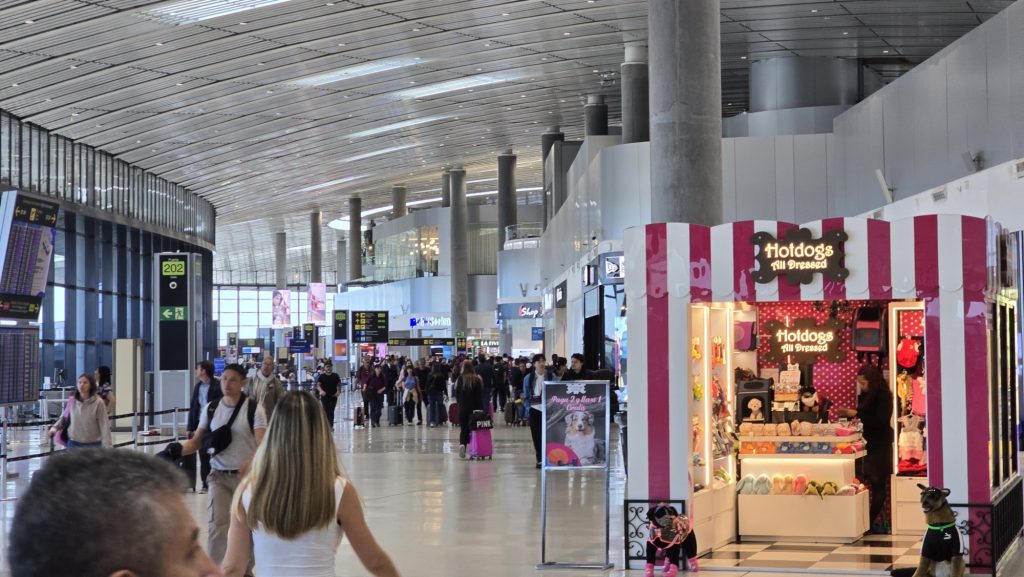
How much is Tocumen International Airport spending on its next expansion? $306.75 million, split between two separate projects: a $208.75 million extension of Terminal 2 called the Muelle Sur (South Pier), and a $98 million overhaul of the airfield itself.
Together they would take Tocumen to 84 aircraft parking positions, up from the current setup, and are designed to carry the airport toward its stated target of 30 million passengers a year by 2030.
What Exactly Is the “Muelle Sur” Project?
The Muelle Sur is a new three-level building of roughly 21,097 square meters, attached to the south end of the Terminal 2 concourse that opened fully in 2022.
It adds 10 new contact boarding gates, reconfigures three existing positions (220, 221 and 222) to line up with the new structure, and adds four remote boarding gates plus a stand for apron buses.
The work is not limited to the building. The contract also covers a new aircraft parking apron, new taxiways around the pier, an extension of the runway access taxiway, fuel supply systems, apron lighting, visual aids and storm drainage.
Why Are They Ripping Up Taxiways That Are Only Four Years Old?
Because they failed. Tocumen’s current administration found deformations in sections of the Terminal 2 aprons and taxiways, which were built with flexible (asphalt) pavement. The Universidad Tecnologica de Panama ran structural testing on the pavement and delivered its findings to the airport.
Based on that report, airport pavement specialists determined the fix, and Tocumen folded it into this tender: remove the existing flexible pavement and replace it with rigid concrete. The stated reasoning is durability, and specifically to stop the cycle of repeat repairs that disrupt operations every time crews go back in.
When Do Bids Close, and Who Wants the Job?
The tender went up on Panama Compra on July 16, 2026. Proposals were originally due August 31, but Addendum 2 pushed the deadline to September 28, 2026, giving bidders 20 extra business days. Ten firms had asked for 60 more days and Mota-Engil asked for 30; Tocumen granted less than requested.
Between 25 and 26 companies and professionals took part in the pre-bid and clarification stage, including Constructora Meco, Constructora Urbana, ICA Constructora, Mallol & Mallol Arquitectos, Ingenieria Estrella, Grupo ITESA, T.Y. Lin, Constructora Nova and Airportgurus. Tocumen’s general manager Jose Ruiz Blanco has cautioned that the number filing actual proposals will be far smaller.
One barrier explains why. Each bidder must demonstrate a single completed project worth at least $75 million within the past 25 years. Adding several smaller contracts together to reach that figure is not allowed.
| Muelle Sur tender terms | Detail |
|---|---|
| Reference price | $208.75 million (exempt from ITBMS) |
| Maximum admissible bid | $250.5 million |
| Published on Panama Compra | July 16, 2026 |
| Proposals due | September 28, 2026 |
| Construction period | 30 months from notice to proceed |
| Maintenance period | 12 months after completion |
| Minimum single-project experience | $75 million, not aggregable |
| Price weighting in evaluation | 40% |
What Does the $98 Million Airfield Project Cover?
The second project is formally titled the study, design, construction and maintenance for the expansion, adaptation and integral improvement of the airfield. It runs 27 months plus one year of maintenance, and it touches runways, taxiways and aprons across the complex.
Its headline component is eight new remote aircraft positions in the north sector of Terminal 1, near the Muelle Norte. They are configured for Code C aircraft such as the Boeing 737, but sized to also accept Code E widebodies like the Boeing 777.
What Does Tocumen Look Like When Both Are Finished?
| Capacity after both projects | Positions |
|---|---|
| Contact positions (jet bridges) | 64 |
| Remote positions | 20 |
| Total aircraft positions | 84 |
Ruiz Blanco has framed the combination of new gates, new remote stands, the new apron and the recovered taxiways as infrastructure built for the demands of the years ahead rather than for today’s traffic.
Is the Demand Actually There?
Yes, and it is accelerating. Between January and June 2026, Tocumen moved more than 11.5 million passengers, a 15% increase over the same period in 2025. The airport maintains direct service to more than 94 international destinations plus one domestic route, and management expects to clear 22 million passengers for the full year.
More than 75% of Tocumen’s passengers are international transit travelers, which is the whole point of the expansion. The airport’s value is as a connecting node between Central America, South America, North America, Europe and the Caribbean, and connecting banks require aircraft to be on the ground simultaneously. Gates, not seats, are the constraint.
In April 2026, Tocumen ranked third among megahubs in Latin America and the Caribbean in the OAG Megahubs index, ahead of airports in Brazil, Peru and Chile.
The Financial Caveat Worth Knowing
Tocumen carries debt of roughly $1.8 billion, and principal payments begin in 2027. That timing overlaps almost exactly with the construction window for both projects, which raises the stakes on delivering them within budget and on schedule. It is a reasonable thing for anyone tracking Panama’s infrastructure story to keep an eye on.
Why an Airport Tender Matters Outside Panama City
Nearly every international buyer, visitor and returning resident enters the country through Tocumen, regardless of where they are actually headed. A traveler landing for a property tour in Boquete, a beach house search near Coronado, or an island trip to Bocas del Toro connects through the same terminal as someone buying a tower unit in Panama City.
Gate capacity is what lets airlines add routes. Routes are what make a second home in Panama practical to actually use rather than aspirational to own. That chain runs through the two contracts now sitting on Panama Compra.
Casa Solution Can Help
If improving air connectivity is part of why you are looking at Panama, whether for a relocation, an investment property or a place to spend part of the year, Casa Solution’s team can help you evaluate which market fits how you actually plan to travel. Reach out to start the conversation.
Article written: September 6, 2026